
Use an AI sales assistant to turn account history, previous conversations, and internal updates into a meeting brief with evidence, open questions, and a proposed next step. For your 2026 evaluation, judge the assistant on whether the brief helps your team make decisions—not whether it produces a polished summary. Keep unsupported claims out of the brief and review any proposed customer commitment before the meeting.
- An AI sales assistant should produce a decision-ready meeting brief, not just summarize account notes.
- Computer fits teams evaluating shared company context for sales meeting preparation and cross-functional work.
- Separate confirmed facts, working hypotheses, and open questions before sharing a brief.
- Test preparation quality against source records, conflicting updates, and the meeting’s actual objective.
How do you use an AI sales assistant for meeting preparation?
Give the assistant a specific meeting objective, relevant account records, and a defined output format. Then check the brief against the original records before using it with a customer. The output should tell you what matters, what remains uncertain, and what to ask next.
Start with the account background. The AI sales assistant account research guide covers the research task that feeds meeting preparation; the workflow below turns that background into a plan for a specific conversation.
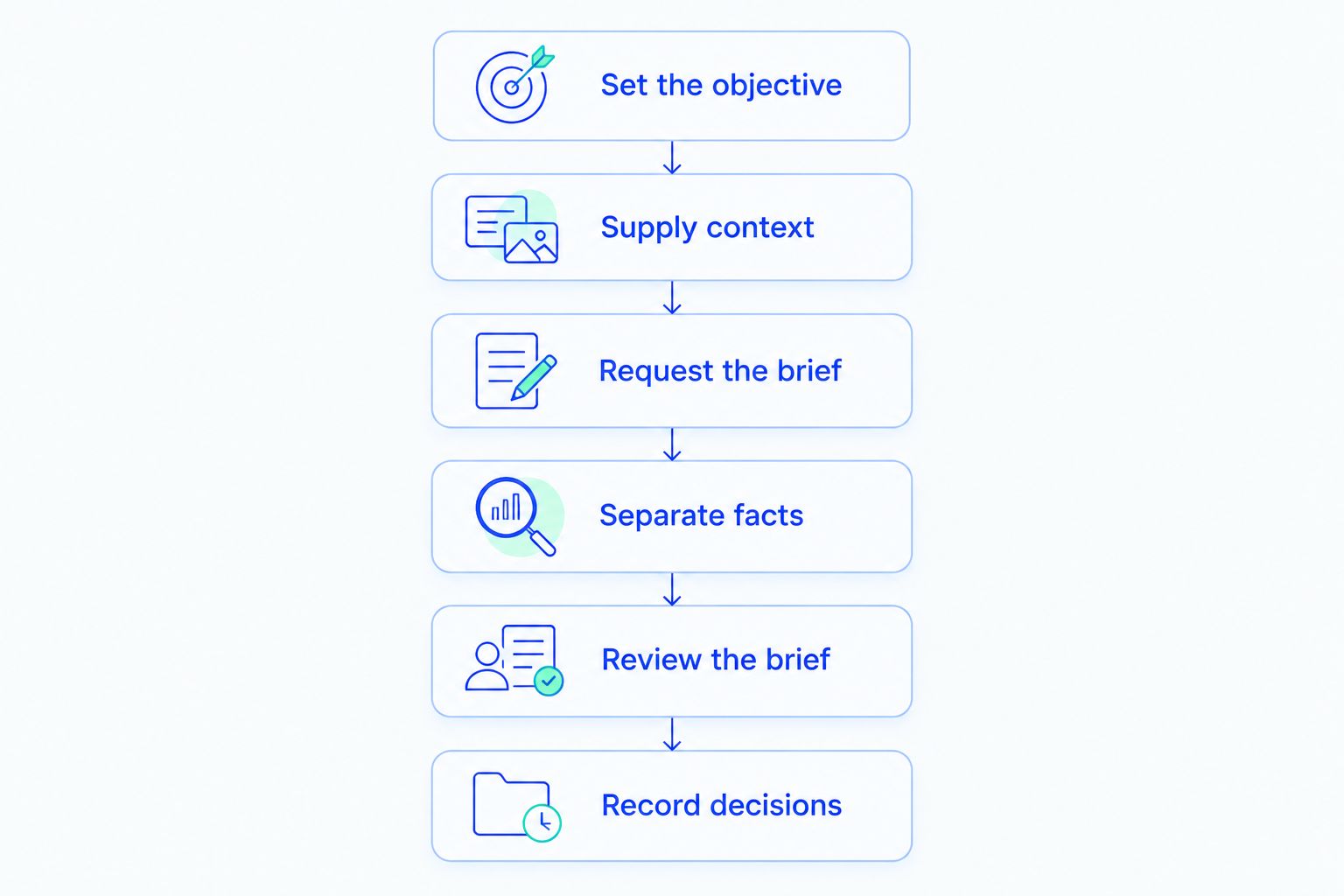
Set the meeting objective
Describe the decision the meeting should advance. A request to summarize an account leaves the assistant to choose what matters; a request to identify unresolved implementation questions gives the brief a useful boundary.
For example, ask for preparation for a renewal discussion where the team needs to understand adoption concerns and confirm who owns the next decision. Include the meeting participants and their roles when you have that information. Do not ask the assistant to infer authority from job titles alone.
A useful instruction is: Prepare me to confirm the customer's current priorities, resolve outstanding questions, and agree on an owner for the next step. Exclude background that does not affect those goals.
Supply the relevant company context
Choose records that explain the relationship, not just the customer's business. Relevant material includes previous meeting notes, account updates, support discussions, and approved internal decisions when those records are available to your team.
Make the scope explicit. Tell the assistant which account and meeting the material concerns, which records are current, and which documents represent historical context. A correct fact from an old conversation still needs a date before it becomes useful preparation.
Keep access boundaries intact. A meeting-preparation request is not a reason to expose records the participants are not authorized to use.
Ask for a decision-ready brief
Request a brief of 1 page, with separate sections for the meeting goal, confirmed context, unresolved issues, questions, and proposed next steps. Treat this as an editorial limit, not a product capability or a performance benchmark.
Ask for 5 questions tied to gaps in the evidence. Each question should explain what the answer would change: the proposed timeline, the meeting agenda, the people involved, or the next action.
This constraint prevents an account summary from becoming a transcript replacement. You need enough context to lead the conversation, not every detail the assistant can retrieve.
Separate facts from hypotheses
Require the assistant to distinguish confirmed facts, working hypotheses, and open questions. Ask for the source and date beside each important factual claim when the assistant supports that output; otherwise, attach and check the evidence yourself.
A support discussion about an unresolved issue is evidence of that discussion. It is not proof that the customer will delay a renewal. Keep the interpretation separate so the seller knows what to investigate rather than repeat as fact.
When records disagree, preserve the disagreement. A smooth sentence that hides conflicting information is worse preparation than an explicit question.
Review the brief with the account owner
Check the customer’s priorities, previous commitments, unresolved problems, and names of decision-makers against the underlying material. Give the account owner responsibility for resolving discrepancies before the brief reaches a wider audience.
Remove conclusions that depend on missing evidence. Replace an unsupported statement about customer intent with a question the seller can ask directly.
Finally, check that the proposed agenda fits the actual meeting. A technically accurate brief can still waste the conversation if it focuses on issues the participants cannot resolve.
Turn preparation into follow-through
After the meeting, compare the brief with what the customer actually said. Identify which assumptions were confirmed, which were wrong, and which questions remain unanswered.
Record decisions, owners, and agreed next steps in your team’s normal system of record. Ask the assistant to help draft the follow-up, then review customer-facing wording and commitments before sending it.
Meeting preparation is useful when it improves the next conversation and leaves better context for the conversation after that.
Why this matters
A seller can know the account’s public story and still miss the internal detail that changes the meeting. An unresolved service issue, an earlier promise, or a revised project scope belongs in preparation when it affects the conversation.
For a 2026 buying decision, test that connection between company context and useful output. A generic summary demonstrates writing ability. A brief that accurately identifies a relevant unresolved commitment demonstrates preparation value.
The distinction matters beyond sales. Finance can clarify a commercial question, operations can confirm delivery responsibilities, and support can explain an outstanding issue. The assistant should help the seller prepare with that context—not speak for those teams without confirmation.
Match the brief to the meeting
Different meetings need different evidence. Use the following formats as evaluation tasks, not as claims about any product’s supported integrations or automatic actions.
| Preparation format | Best for | Context to supply | Useful output | Limitation to check |
|---|---|---|---|---|
| Discovery brief | Learning an unfamiliar account’s priorities | Available account research and previous correspondence | Evidence-based background and open discovery questions | Public research does not establish internal buying intent |
| Renewal brief | Reviewing an existing relationship | Prior commitments, account updates, and relevant service discussions | Unresolved issues and questions about the next decision | Historical satisfaction does not prove current sentiment |
| Executive brief | Aligning a senior conversation around decisions | Confirmed goals, previous decisions, and unresolved trade-offs | A focused agenda and decisions needed | Too much operational detail obscures the purpose |
| Handoff brief | Transferring responsibility between teams | Agreed scope, owners, dependencies, and outstanding questions | A clear account of commitments and missing ownership | A summary does not replace acceptance by the receiving team |
Choose the format by the decision, not the seller’s job title. An executive meeting about a delivery problem needs operational evidence. A renewal meeting involving a new stakeholder needs questions that establish that person’s priorities.
An illustrative renewal-preparation task
Suppose your account notes describe an expansion discussion, while a later service update records an unresolved implementation question. This is an illustrative scenario, not a reported customer result.
Give the assistant both records and ask for the evidence that affects the renewal conversation. The useful output names the unresolved question, identifies the latest documented position, and suggests asking whether implementation progress affects the customer’s plans.
Assess the brief by checking whether it preserves that uncertainty. Reject wording that declares the renewal at risk without supporting evidence or treats expansion interest as a confirmed commitment.
Why meeting-preparation quality varies
Use these factors to diagnose weak briefs during your 2026 evaluation:
- Source coverage. A brief based only on account notes cannot represent relevant discussions that were never included. Check the evidence set before blaming the wording.
- Record freshness. Older material needs dates and context. Ask which update establishes the latest documented position.
- Meeting purpose. A discovery call and a handoff require different questions. Give the assistant the decision the conversation should advance.
- Conflicting evidence. Require disagreements to remain visible until someone resolves them. Do not accept confident synthesis as proof.
- Review ownership. Name the person who checks the brief and approves commitments. Shared preparation still needs accountable judgment.
Better prompts help define the task. They do not repair missing records, establish customer intent, or authorize a commitment.
What should you ask an AI sales assistant before a meeting?
Ask an AI sales assistant for a source-backed account brief, unresolved commitments, questions that test assumptions, and a proposed agenda. Tell it to label missing information rather than fill gaps.
Use this reusable request:
Prepare a meeting brief for this account and these participants. State the meeting objective. Separate confirmed facts, working hypotheses, and open questions. Identify relevant previous commitments and conflicting updates. Include the source and date for important claims where available. Propose questions that close evidence gaps and a next step for discussion. Do not invent customer intent, authority, deadlines, or commitments.
Add the meeting type and the relevant records. Review the result as preparation material, not as an approved customer message.
Can an AI sales assistant replace account-owner preparation?
An AI sales assistant can organize the material you provide, but the account owner remains responsible for the meeting plan and customer commitments. Use the draft to focus human review, not remove it.
The seller should be able to explain why each proposed question belongs in the meeting. If the answer is merely that the assistant suggested it, the brief needs another review.
How should you evaluate Computer for meeting preparation?
Computer is best for teams evaluating an AI teammate built around shared company context, not sales-only assistance. Computer connects a company’s accounts, teams, and systems through native shared memory to support business answers and actions.
For meeting preparation, evaluate what that shared context means in practice: can your team obtain useful answers grounded in the relevant company information? Treat that as a trial question, not an assumed result. Check the connections, evidence access, and output behavior your team actually needs.
Computer Pro offers a 30-day free trial. Use the 2026 evaluation to test a recurring task with an accountable owner, then judge the output against the original records.
The fit is cross-functional context. The trade-off to investigate is whether the available information and review workflow meet your team’s needs; shared memory does not remove the need to check a brief.
Include an adjacent task, such as a daily briefing, internal research summary, or follow-up draft. This tests whether Computer fits the wider company rather than only the sales preparation workflow.
Test your meeting-preparation workflow
Use the Computer Pro 30-day free trial to evaluate briefs against your team's source records.
FAQ
What's the best way to use an AI sales assistant before a meeting?
Use an AI sales assistant to prepare a source-backed brief around the meeting's objective. Supply relevant account records, ask for unresolved issues and useful questions, and review the result before using it.
What information should I give an AI sales assistant for meeting preparation?
Provide the meeting objective, participants, relevant account history, previous commitments, and current internal updates. Include only information your team is authorized to use and identify historical records clearly.
How long should an AI-generated meeting brief be?
Use 1 page as an initial editorial limit for a meeting brief. Keep evidence references accessible separately so a short brief does not hide unsupported claims.
Can an AI sales assistant tell me what a customer will decide?
An AI sales assistant's prediction is not confirmation of a customer's decision. Separate documented statements from working hypotheses and ask the customer to resolve uncertainty.
How do I check whether a meeting brief is accurate?
Check consequential claims against their original records, including dates and conflicting updates. Pay particular attention to commitments, customer intent, responsibilities, and proposed deadlines.
Is Computer only for sales teams?
Computer is an AI platform for business teams across the company, not a sales-only tool. Its native shared memory connects a company's accounts, teams, and systems to support answers and actions.
Does Computer Pro offer a free trial?
Computer Pro offers a 30-day free trial. Use it to evaluate a defined team workflow and compare the output with the source material before deciding whether it fits.
One last thing
For your 2026 trial, choose an account with a known contradiction in its records. Give the assistant the relevant material without explaining the discrepancy, then check whether the brief exposes it or silently chooses a version.
The brief that reveals a conflict gives your seller something useful to resolve. Fluent wording alone does not pass that test.