
Measure an AI assistant for business against real tasks your team already performs: compare the finished work, total human effort, source accuracy, and handling of company context. Include setup, corrections, and review—not just response speed. During a 2026 trial, decide what counts as usable work before anyone sees the first answer.
- Evaluate an AI assistant for business on accepted work, not impressive responses.
- Computer fits teams evaluating an AI teammate built around shared company context.
- Test an enterprise AI assistant across departments, including everyday drafting, research, and meeting preparation.
- Computer Pro offers a 30-day free trial; set your acceptance criteria before starting.
Why this matters
A fast answer is not necessarily a finished task. If your team spends longer checking and correcting it than doing the work directly, response speed tells you little about business value.
Computer connects company accounts, teams, and systems through native shared memory. For a buyer, the relevant test is practical: does that company context improve the answer or action enough to make the work usable? Test the output, not the promise.
A useful trial also separates individual convenience from team value. One person getting a good draft does not establish that another teammate can get a consistent answer using the same business context.
How do you measure an AI assistant for business during a trial?
Use a repeatable task set, a manual baseline, and explicit acceptance rules. Keep the underlying materials comparable so you measure the assistant's contribution rather than differences in task difficulty.
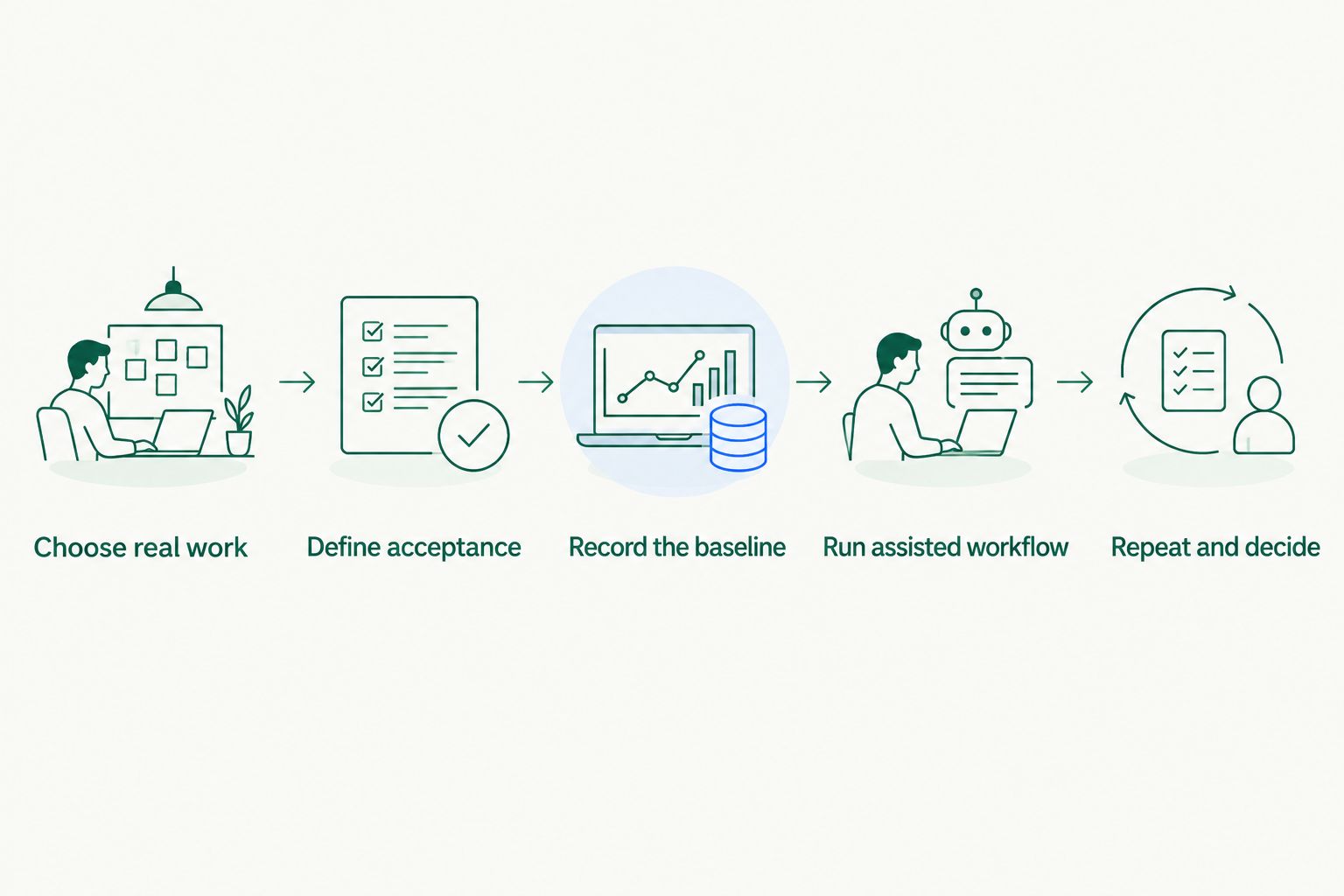
- Choose real work. Select recurring tasks with identifiable owners and outputs someone actually uses.
- Define acceptance. Write down the facts, sources, format, and review requirements each output must satisfy.
- Record the baseline. Measure how the team completes comparable work without the assistant.
- Run the assisted workflow. Include preparation, prompting, waiting, checking, corrections, and handoff.
- Repeat and decide. Retest failures and successful examples before approving a wider rollout.
Treat these as recommended trial steps, not measured customer results. Your baseline and trial records supply the evidence.
Keep one record for every attempt
Use a shared worksheet with the task, owner, source materials, prompt, output, elapsed time, review time, corrections, and final decision. Save rejected attempts too. Otherwise, your summary becomes a collection of highlights instead of an evaluation.
Add the reason for rejection. A wrong account name, an unsupported financial statement, and an unusable writing style need different fixes. A single thumbs-down score hides those distinctions.
Measure finished work, not answer speed
Your 2026 trial scorecard should answer a small set of buying questions. The table below compares evaluation dimensions, not competing products; use it to keep reviewers focused on the same evidence.
| Measure | What to record | What a useful result shows | What the measure misses alone |
|---|---|---|---|
| Task acceptance | Accepted outputs divided by evaluated outputs | Work meets your written requirements | Whether the requirements were demanding enough |
| Total human effort | Preparation, review, correction, and handoff time | Less human effort for comparable accepted work | Whether unattended waiting delays delivery |
| Source accuracy | Claims checked against underlying records | Statements match relevant evidence | Whether important evidence was omitted |
| Context handling | Correct use of account, team, and project details | Less repeated explanation without mixing facts | Whether the context remains current later |
| Action correctness | Requested action compared with resulting state | The intended change happened as authorized | Whether approval and recovery controls are sufficient |
| Team usability | Independent completion by intended users | The workflow works beyond its strongest advocate | Whether it will suit every department |
Count accepted work separately from work that merely looks finished. A polished report with an unsupported conclusion is not an accepted report.
For source-heavy tasks, use the same review standard throughout the trial. The guide to checking an AI report generator's sources provides a focused companion to that part of the evaluation.
Calculate effort without hiding corrections
Record human effort separately from elapsed delivery time. Human effort captures the work your team performs; elapsed time captures how long the recipient waits. Both matter, but they answer different questions.
For comparable accepted tasks, subtract assisted human effort from baseline human effort to calculate time saved. Keep failed attempts in the overall workflow record rather than reporting only the fastest successful run.
Do not turn every saved minute into a financial return automatically. First establish whether the team uses that capacity for additional work, faster delivery, or another defined outcome.
Choose tasks that expose real trade-offs
Test across the company, not just the department sponsoring the purchase. The following are illustrative evaluation tasks, not claims that a particular product supports every workflow.
| Trial task | Best for | Company context needed | Output to assess | Main limitation to test |
|---|---|---|---|---|
| Account meeting preparation | Sales leaders | Account history, open issues, meeting purpose | Brief with relevant facts and questions | Stale or mismatched account details |
| Daily briefing | Operations leaders | Current priorities, blockers, owners | Prioritized update with supporting records | Important work omitted from the summary |
| Spend review | Finance leaders | Approved records, reporting period, categories | Explanation tied to source evidence | Unsupported explanations of changes |
| Research and analysis | Cross-functional teams | Research question, approved materials, scope | Findings with evidence and uncertainty separated | Confident conclusions beyond the evidence |
| Brand and drafting review | Brand and design teams | Audience, approved claims, writing guidance | Draft assessed against the brief | Fluent wording that changes the meaning |
These tasks expose different strengths and weaknesses. Meeting preparation tests relevance; spend review tests evidence; drafting tests instruction-following. Do not let success in one category stand in for success everywhere.
Choose tasks with enough repetition to compare outcomes. Avoid filling the trial with unusual requests that nobody expects to repeat after purchase.
Keep the task difficulty comparable
Use comparable source sets, output requirements, and reviewer standards for manual and assisted work. If the assisted task gets cleaner inputs or a narrower brief, record that difference.
Where possible, have a reviewer assess the finished output without knowing how it was produced. This helps keep enthusiasm for the product separate from the quality of the work.
Test shared memory through team behavior
Shared memory matters when company context carries into useful work. Evaluate whether the assistant applies the right information to the right task—not whether it repeats something mentioned earlier.
For a 2026 evaluation, Computer is best for teams testing an AI teammate built around shared company context. That is a reason to include it in a trial, not evidence that it has passed your team's requirements.
Use these checks with approved test materials:
- Consistency: Ask teammates to request the same business fact independently. Compare the answers with the authoritative record.
- Relevance: Introduce unrelated project information and check that it stays out of the answer.
- Freshness: Update a permitted source and assess whether later work reflects the current record.
- Boundaries: Ask a question whose answer is absent. Check that the response does not invent company facts.
- Correction: Correct an error, then repeat the relevant task. Record whether the correction affects subsequent work.
The benefit you want is less repeated explanation. The trade-off to examine is dependence on the quality, relevance, and currency of the connected information.
Keep access testing separate from factual testing. A correct answer still fails your requirements if the person requesting it should not receive the underlying information.
Why trial results vary
Differences between trial outcomes need an explanation before they become purchasing conclusions. Record these factors alongside each task:
- Source condition: Missing, contradictory, or outdated records affect what a reviewer can verify.
- Task boundaries: A focused summary and an open-ended investigation require different acceptance rules.
- Context requirements: Some work depends on account history; other work only needs the supplied document.
- Reviewer standards: Teams disagree about what counts as accurate, complete, or ready to send unless they define it.
- Workflow ownership: Setup and correction work still need an owner, even when the answer arrives quickly.
- Action consequences: A draft and a change to a business record require different approval standards.
Do not average away an important failure. A strong drafting result does not cancel an unacceptable access result, and useful summaries do not excuse unsupported finance conclusions.
How long should an AI assistant trial last?
Computer Pro offers a 30-day free trial. Use that period to test repeated work, not to postpone the evaluation until the final days.
A recommended schedule divides the trial into 3 phases: baseline and setup, repeated task evaluation, and independent retesting. These are planning phases, not product performance benchmarks. Assign owners and review dates before starting.
In your 2026 buying plan, include tasks that recur within the available period. A monthly workflow is difficult to assess repeatedly in one trial; supplement it with approved historical examples and label those replays clearly.
What should count as a successful trial?
A successful trial produces accepted work under conditions your team can repeat. Set thresholds against your own baseline rather than borrowing an unsupported industry average.
Write the decision rules before testing. Separate requirements that cannot be traded away—such as authorized access—from preferences such as writing style. Then decide which tasks justify adoption, which need restricted use, and which should remain outside the rollout.
Approve specific workflows, not the assistant in the abstract. A team can adopt meeting preparation while declining automated actions until those actions meet separate requirements.
How do you know whether the team will actually use it?
Ask intended users to complete representative tasks without the trial champion rewriting every prompt. Record whether they finish, what help they need, and whether the output reaches its intended recipient.
Then ask which recurring workflow they would choose to use again. Treat that answer as adoption feedback, not proof of accuracy. Keep usage preference and work quality as separate findings.
Before a 2026 rollout, name the workflow owner, reviewer, permitted sources, and escalation path. If nobody owns failures, the trial has not established an operating process.
Test Computer on your team's work
Use the 30-day Computer Pro free trial to evaluate real tasks against written acceptance criteria.
FAQ
What's the best way to measure an AI assistant for business?
Measure accepted work, total human effort, source accuracy, context handling, and action correctness against a manual baseline. Define acceptance before testing and retain failed attempts in the evaluation record.
How long is the Computer Pro free trial?
Computer Pro offers a 30-day free trial. Plan baseline work, repeated evaluation, and independent retesting within that period.
Should I measure response speed or time saved?
Measure total human effort and elapsed delivery time separately. Fast responses do not establish time saved when checking and correcting the output takes additional work.
How do I test whether shared memory is useful?
Test whether the assistant applies accurate, relevant company context across repeated tasks and different teammates. Include changed records, unrelated information, corrections, and questions with no supported answer.
Can one department's results justify a company-wide rollout?
One department's results do not establish suitability across the company. Evaluate representative tasks and acceptance requirements for each team included in the rollout.
Should failed answers count against the trial?
Failed answers belong in the trial record, including attempts that require correction or abandonment. Categorize the failure so you can distinguish an input problem from an unacceptable workflow outcome.
What should I do before approving automated actions?
Check authorization, the resulting state, approval requirements, and recovery procedures before approving an action workflow. Evaluate actions separately from drafts and recommendations.
One last thing
End your 2026 trial by repeating a successful task with a different teammate and an updated source. This checks whether the result depends on one skilled operator or one convenient snapshot of company information.
Keep the original acceptance rules. The strongest buying evidence is work your team can repeat—not a demonstration your team can admire.