
Evaluate an AI teammate by testing real work with your team, checking the company context behind each answer, and reviewing what happens when information changes. Use the same tasks and acceptance criteria throughout the evaluation, rather than judging a polished demonstration. Approve adoption only when the output meets your team's standards without hiding correction work or unclear action boundaries.
- Evaluate an AI teammate on real tasks, changing company context, and reviewable outputs—not a polished demonstration.
- Computer fits teams evaluating an AI assistant for business around shared organizational memory.
- Use a shared scorecard to separate answer quality, context accuracy, correction work, and action control.
- Computer Pro offers a 30-day free trial; use it to test repeat work across teams.
Why this matters
Your team needs useful work, not convincing paragraphs. A meeting brief that misses a recent account decision fails even when every sentence reads well. An operations summary that presents an unresolved issue as settled creates more review work.
For your 2026 evaluation, start with the work your team already checks carefully. Computer connects company accounts, teams, and systems through native shared memory. The buying question is whether that shared context produces answers and actions your team can trust on its own tasks.
Computer is best suited to teams evaluating an AI teammate around shared company context, not isolated prompts. Test that fit directly; do not treat the positioning as proof of performance.
How do you evaluate an AI teammate with your team?
Use a controlled team trial. Choose representative work, define what a correct result contains, and have the people responsible for that work review the output. Keep the assignment stable enough to compare results while deliberately changing selected source information.
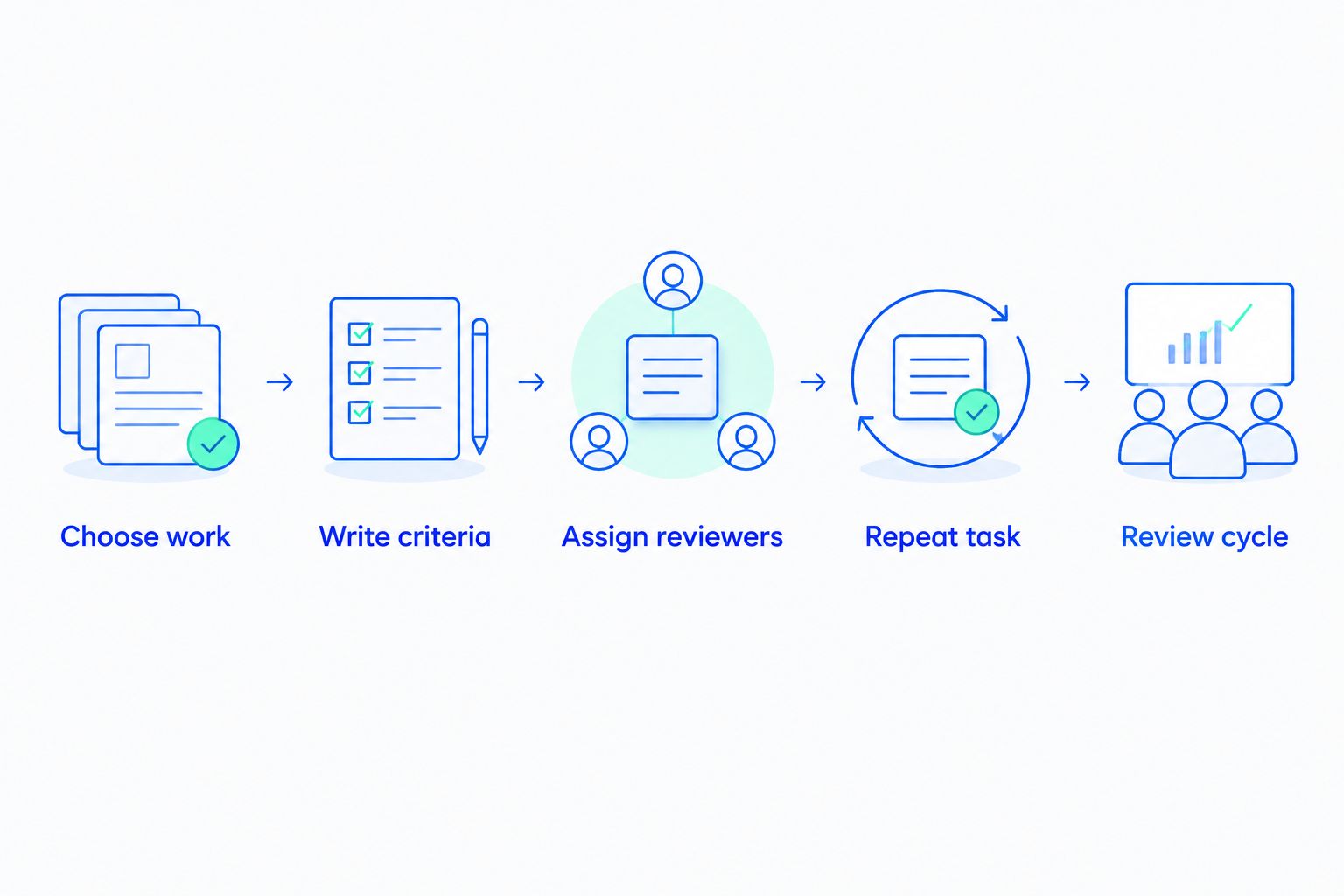
1. Choose work your team can judge
Select 3 recurring tasks with clear owners. Include a task that combines information across teams, a task that depends on a recent change, and a task that produces a draft someone must approve.
Do not choose only easy summaries. Include a situation where the correct response is to identify missing information rather than complete the assignment with an assumption. That tests judgment as well as fluency.
2. Write the acceptance criteria first
For each task, record the intended audience, required company context, expected output, and unacceptable mistakes. Have the task owner write a reference answer or checklist before reviewing the generated result.
Keep style preferences separate from factual requirements. A leader might prefer shorter paragraphs; an incorrect renewal date is a different class of problem. Your scorecard must preserve that distinction.
3. Assign independent reviewers
Use 2 reviewers for each selected task: the person who normally does the work and someone who receives or acts on it. Ask both to assess the output before discussing their verdicts.
The author knows what preparation requires. The recipient knows whether the result supports a decision. When their assessments disagree, inspect the specific claim or missing detail instead of averaging away the disagreement.
4. Repeat the task after context changes
Update an approved source with a material change, then repeat the assignment. For example, change an account's next step or revise the owner of an operational issue. These are illustrative test scenarios, not reported customer results.
Check whether the output reflects the change, identifies conflicting information, or repeats an outdated conclusion. A useful first answer does not establish that later answers remain dependable.
5. Review the whole work cycle
Record preparation, prompting, checking, correction, and final approval. Do not assess only the generation step. If a reviewer has to reconstruct the original research to approve the answer, that work belongs in the evaluation.
For a 2026 buying decision, keep the completed artifacts alongside the scorecard. A collection of approved briefs, rejected drafts, and documented failures is more useful than a general impression that the tool felt helpful.
Test work across the company
An enterprise AI assistant evaluation should include more than sales. Use the examples below as task designs, not statements that any product supports every workflow. Verify required connections and actions before including them in your trial.
| Evaluation task | Best for | Company context needed | Expected output | Main limitation to test |
|---|---|---|---|---|
| Daily briefing | Team leaders preparing priorities | Current commitments, decisions, unresolved issues | Prioritized brief separating facts from open questions | Missing context can distort priorities |
| Meeting preparation | Sales and customer-facing teams | Account history, recent discussions, agreed next steps | Brief with objectives, open questions, and relevant changes | An old decision can look current |
| Research and analysis | Teams assessing a business question | Approved research, internal assumptions, decision criteria | Findings that distinguish evidence from interpretation | A fluent conclusion can exceed the evidence |
| Operations report | Operations owners tracking work | Status updates, owners, dependencies, blockers | Report with unresolved issues and next decisions | Conflicting status updates require resolution |
| Finance narrative | Finance teams explaining a report | Approved figures, reporting period, documented explanations | Draft commentary tied to the supplied figures | Unsupported causal explanations need rejection |
| Brand and design brief | Marketing and design leads | Approved positioning, audience, campaign goals | Brief with requirements and explicit assumptions | Generic ideas can miss company constraints |
| Drafting | Anyone preparing internal communication | Audience, approved facts, intended decision | Editable draft with unresolved details identified | Good wording does not establish accuracy |
Each task offers a concrete output you can inspect. Each also exposes a failure mode. Choose tasks because your team can verify them, not because they produce an impressive demonstration.
What should a sales test include?
For an AI sales assistant evaluation, ask for meeting preparation around an account your reviewer knows well. Supply approved context, including a recent change, and request a brief that separates established commitments from proposed next steps.
Reject invented customer intentions, unsupported deal claims, and outdated account details. Assess whether the brief helps the seller prepare without replacing account judgment with confident assumptions.
What should finance and operations test?
For AI for finance teams, use approved figures and require the draft to separate reported changes from explanations that need confirmation. The reviewer should trace each numerical statement back to the supplied material.
For AI for operations, test a report containing an unresolved dependency. A useful result keeps that dependency visible instead of converting partial progress into a completed status. The same principle applies when evaluating an AI report generator: polished formatting does not excuse incorrect substance.
Test Shared Memory through changed information
Shared Memory matters when company context carries across work instead of being rebuilt for every request. The practical question is whether the next answer reflects the right context—not whether the product uses the phrase prominently.
Computer's native shared memory connects company accounts, teams, and systems. The advantage to test is continuity across work; the limitation to examine is whether incomplete or conflicting context still requires manual reconstruction. Judge both with your own material.
Use a controlled sequence:
- Establish context. Provide an approved account decision or project update.
- Request output. Ask for a brief or report that depends on that information.
- Change context. Revise a meaningful fact in the source used for the test.
- Check continuity. Repeat the task and inspect which version informs the answer.
Keep these checks separate from writing quality. An elegant answer based on the wrong version fails the task. A response that explicitly identifies a conflict gives the reviewer something concrete to resolve.
Your 2026 evaluation should also include a new request about the same work. That distinguishes repeating an answer from applying relevant context to a different question.
Why AI teammate results vary
When results differ, identify the cause before changing the prompt repeatedly. Otherwise, you risk building a trial that rewards whoever spends the most time repairing instructions.
- Source completeness. Missing decisions or incomplete records limit what the assignment can establish.
- Source freshness. An outdated update can conflict with the team's current understanding.
- Task clarity. An undefined audience or deliverable leaves the acceptance standard unclear.
- Cross-team context. A sales brief and a finance narrative require different facts, even about the same account.
- Review requirements. Drafting an internal note and preparing a consequential action require different approval checks.
- Information boundaries. The evaluation must establish what each participant is permitted to access or change.
These are evaluation factors, not excuses for a failed output. Document the failure, identify the cause, and repeat only after making a deliberate change. Preserve the original result so the final decision reflects the actual work required.
Use a scorecard that exposes correction work
Keep the 2026 scorecard simple enough for every reviewer to use. Mark each criterion Pass, Needs correction, or Fail, then attach the specific evidence behind the verdict.
| Criterion | Pass condition | What to record when it fails |
|---|---|---|
| Factual accuracy | Claims match approved source material | Incorrect claim and its correct source |
| Context accuracy | Current decisions and relevant constraints appear | Missing, stale, or conflicting context |
| Evidence traceability | Reviewers can establish the basis of important claims | Claims that require unsupported trust |
| Output usefulness | The deliverable meets the agreed task requirements | Missing sections or unusable recommendations |
| Correction work | Necessary edits are visible and documented | Rewriting, repeated prompting, or extra research |
| Action control | Any tested action follows agreed review boundaries | Unclear approval or an unintended change |
Do not collapse these criteria into a single impression. A useful draft with a factual error still needs correction. An accurate answer that does not address the assignment still fails usefulness.
Treat unexplained access and uncontrolled actions as stop conditions for the affected workflow. Ask the vendor to demonstrate the relevant behavior before extending the test. Do not infer security assurances from a successful writing task.
Turn the trial into an adoption decision
Computer Pro offers a 30-day free trial. Use that period for repeated work, not a final-day demonstration. Start with approved test material, document the initial results, and repeat the selected tasks after context changes.
For your 2026 decision, separate approved use cases from unresolved ones. Your team can accept a drafting workflow while withholding approval for actions that need further validation. Adoption does not require treating every task as equally ready.
End the trial with a short decision record:
- Approve: Name the task, owner, review requirement, and accepted output.
- Retest: State the failure and the specific change required before another assessment.
- Reject: Identify the requirement the workflow did not meet.
Choose the next step from that record. Do not let enthusiasm about one strong output erase repeated failures elsewhere.
Test your team's real work
Use the 30-day Computer Pro trial to assess shared context, output quality, and correction work.
FAQ
What's the best way to evaluate an AI teammate?
Evaluate an AI teammate with repeatable tasks, written acceptance criteria, and reviewers who know the work. Check accuracy, current context, correction effort, and action boundaries before approving a workflow.
How many tasks should our team test?
Start with 3 recurring tasks: one that combines team context, one that depends on changed information, and one that produces an approval-ready draft. This is a practical starting plan, not a performance benchmark.
Who should review the AI teammate's work?
Use 2 reviewers per task: the person responsible for producing the work and someone who receives or acts on it. Have them assess the output independently before comparing judgments.
How long is the Computer Pro free trial?
Computer Pro offers a 30-day free trial. Use the period to repeat real assignments and test how outputs respond when company context changes.
How do we test whether shared memory helps?
Test shared memory by changing an approved source and checking the next relevant answer. Inspect whether the output reflects the change or identifies a conflict rather than repeating an outdated conclusion.
Can we evaluate sales, finance, and operations together?
Evaluate sales, finance, and operations within the same trial, but give each workflow its own acceptance criteria. Verify the required connections and actions rather than assuming every task is supported.
What should stop an AI teammate rollout?
Stop the affected workflow when reviewers cannot establish factual accuracy, permitted information access, or control over consequential actions. Resolve the specific failure before expanding that workflow.
One last thing
Save a failed answer and test it again after correcting the underlying context. That single exercise separates a better-looking response from a genuinely resolved problem.
Your adoption decision should name the work the team can now approve, the checks it still requires, and the workflows that remain out of scope. That is a stronger outcome than a trial full of impressive answers nobody is prepared to use.