
Sales teams’ use of AI is the application of company context to account research, meeting preparation, drafting, and analysis with the aim of improving sales decisions and execution. This 2026 guide shows you how to roll it out without confusing a polished answer with an accurate one; sales work depends on changing account details and commitments that other teams must honor.
- AI for sales teams starts with reliable account context, not a larger prompt library.
- Computer is best for teams evaluating a shared-memory AI teammate across sales, finance, and operations.
- Pilot meeting preparation, account research, and follow-up drafting before expanding into actions.
- Judge an AI sales assistant on factual accuracy, useful outputs, and clear approval boundaries.
Why AI matters for sales teams
A sales answer needs more than fluent writing. Your rep needs to know which account the answer concerns, what changed, and whether a promise conflicts with something already agreed elsewhere.
Shared context is the buying criterion. Computer is an AI platform with native shared memory that connects a company’s accounts, teams, and systems. Evaluate that approach against your actual sales work, not an isolated writing demonstration.
For your 2026 rollout, start where sales depends on another team’s knowledge. Meeting preparation, account research, and follow-up drafts give you concrete outputs to inspect. They also expose the difference between an assistant that produces plausible text and one that uses the right business context.
How to roll out AI for sales teams
Choose work you can inspect
Start manually. Ask reps to assemble an account brief from the records they already use, then document how a manager checks it. That manual version becomes your reference, not a competing production process.
Choose 3 pilot tasks: meeting preparation, account research, and follow-up drafting. These are recommended test boundaries, not performance benchmarks. Each produces something a reviewer can compare with source material before a customer sees it.
For meeting preparation, define the task narrowly: summarize the account’s current situation and propose questions for the next conversation. Required context includes recent notes, recorded commitments, and unresolved questions. The output should separate confirmed facts from suggested talking points.
Do not begin with a vague instruction to make reps more productive. You cannot inspect that outcome at the level of an individual answer.
- Meeting preparation: Check account facts, commitments, and unanswered questions.
- Account research: Separate internal knowledge from externally sourced information.
- Follow-up drafting: Check every promise against the approved next steps.
- Acceptance rules: Write down what makes each output usable.
Assemble the account context
Build the first context packet by hand. Use 5 account records that represent different situations in your pipeline, and record why each belongs in the pilot. This is a suggested sample for finding obvious failures, not proof of organization-wide accuracy.
Include the information needed to answer the chosen task. A meeting brief needs a different packet from a financial question about an account. More material is not automatically better; unrelated records make review harder.
Keep a short reference sheet for each account. Identify the source owner, the date of the relevant information, and any unresolved conflict. When two records disagree, make the disagreement visible rather than choosing the version that sounds more convincing.
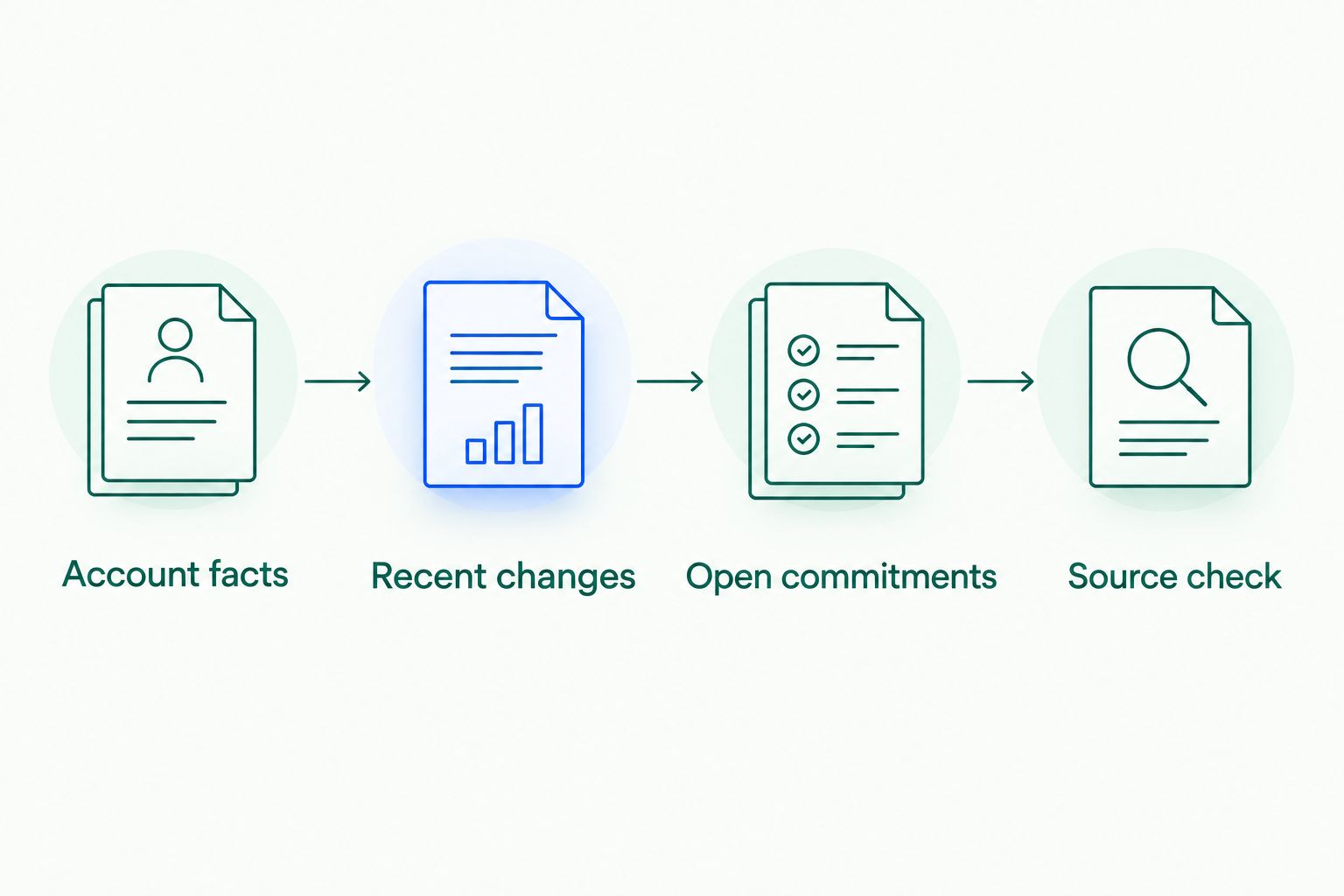
Use this sequence to prepare the packet before testing an assistant:
- Account facts: Identify the correct company and relevant contacts.
- Recent changes: Note updates that affect the next conversation.
- Open commitments: Record promises that still need follow-through.
- Source check: Confirm who owns each important fact.
Test shared memory against manual work
Run the same task using your manually assembled packet first. Then evaluate Computer as the shared-memory path: an AI teammate connecting company accounts, teams, and systems rather than treating each request as disconnected work.
Shared Memory matters when a sales question depends on information beyond a rep’s latest note. An illustrative example is preparing for an account meeting where operations owns an unresolved delivery question and finance owns a separate commercial constraint. The desired brief brings the relevant context together without turning an unresolved issue into a confirmed answer.
Computer Pro offers a 30-day free trial. Use that window for a bounded 2026 evaluation, not an assumption that every workflow or data source is ready. Validate the information available in your environment and inspect the resulting answers.
- Run identical tasks against your manual reference.
- Check whether the correct account context appears.
- Test questions that need another team’s input.
- Record missing, conflicting, or outdated information.
- Verify required connections before expanding the pilot.
Define outputs before writing prompts
Draft the expected output manually before asking an assistant to produce it. This prevents a long answer from passing simply because it looks thorough.
For a meeting brief, request the account situation, relevant changes, open questions, and proposed discussion points. For a follow-up draft, request a recap, agreed next steps, and unresolved items. Keep suggestions visibly separate from commitments.
An illustrative follow-up task is straightforward: draft a message after a discovery call using the approved notes. The company context includes the customer’s stated needs, what the rep actually promised, and which questions remain unanswered. The output is a draft for review, not permission to send it.
Assess the draft against the notes. A smoother sentence does not justify an added deadline, unsupported product statement, or invented agreement.
- Specify the audience and purpose of the output.
- Name the records the answer should use.
- Separate confirmed facts from recommendations.
- Ask for unresolved questions to remain visible.
- Reject promises absent from the source material.
Set boundaries for answers and actions
Write the approval rules in a shared document first. An answer helps someone decide; an action changes something or communicates a decision. Those need different review standards.
Start with read-and-draft tasks. Before allowing any workflow to change records or communicate externally, verify the exact action, available controls, and approval process. Do not infer those capabilities from an assistant’s ability to describe what should happen.
Use 2 reviewers for the pilot’s consequential outputs: a sales owner and the relevant subject owner. This is a recommended review arrangement, not a claim about a product’s built-in workflow. Finance reviews commercial constraints; operations reviews commitments within its remit.
If a draft depends on unresolved input, keep it unresolved. Your rollout should make uncertainty easier to see, not bury it beneath confident language.
- Identify which outputs stay as internal drafts.
- Name the owner of customer-facing approval.
- Verify permissions for every proposed action.
- Define when finance or operations must review.
- Document how to stop and correct a workflow.
Score accuracy before convenience
Use a spreadsheet before building a reporting process. Give each test output a clear disposition: accepted, needs revision, or rejected. Record the reason so your team can distinguish a writing preference from a factual failure.
Judge accuracy and usefulness separately. An account summary can contain correct facts and still omit the issue that matters for the meeting. A follow-up draft can sound appropriate and still assign the wrong owner to a commitment.
For your 2026 evaluation, compare the assistant’s output with the manual reference and the underlying records. Do not treat that reference as infallible either. When reviewers disagree, return to the source and document the resolution.
Measure effort only after the output passes review. Otherwise, a fast draft that requires substantial checking looks better than it is.
- Check account identity and factual accuracy.
- Record material omissions and unsupported additions.
- Assess whether the output supports the intended task.
- Track revisions separately from outright rejections.
- Record preparation and review effort consistently.
Expand across teams with the same checks
Prove the review method in sales, then apply it to adjacent work. An enterprise AI assistant should be evaluated against the company context each team needs, not a single sales demonstration.
Computer is best for teams evaluating a shared-memory AI teammate across sales, finance, and operations. Keep that company-wide scope in the trial while keeping each test small enough to inspect.
Start manually with a reference output for every new use case. A finance analysis needs agreed definitions and reporting inputs. An operations briefing needs current issues and owners. Brand and design work needs an approved brief, while drafting needs a defined audience and supported claims.
Use your 2026 pilot findings to choose the next workflow. Expand because the evidence supports it, not because another department wants access.
- Daily briefings: Check priorities against current team records.
- Finance analysis: Check inputs, calculations, and metric definitions.
- Operations updates: Check issue status and accountable owners.
- Research and analysis: Check evidence and separate interpretation.
- Brand and design: Check recommendations against the approved brief.
- Drafting: Check audience, factual support, and review ownership.
Compare approaches by the context they require
Choose an approach based on the work you need done. A manual process is useful as a reference. A session-based assistant is useful for a bounded task with a prepared packet. A shared-memory platform belongs in an evaluation of connected company work.
These are workflow choices, not verified feature comparisons between named competitors. Test the actual configuration you intend to use.
| Option | Best for | Practical advantage | Key limitation or evaluation requirement |
|---|---|---|---|
| Manual account packet | Establishing a checkable reference | You select the records and inspect the reasoning directly | You must assemble and refresh the packet yourself |
| Session-based AI workflow | Drafting or analyzing a supplied packet | Keeps the task bounded around material you provide | You remain responsible for supplying the context the task needs |
| Computer shared-memory platform | Evaluating an AI teammate across company teams | Connects accounts, teams, and systems through native shared memory | Validate required data coverage, answer quality, and permitted actions in your environment |
Choose the smallest workflow that answers the business question reliably. Shared memory deserves evaluation when account work depends on connected company context. It does not replace source ownership or your acceptance checks.
Start a focused team trial
Use the 30-day Computer Pro free trial to evaluate real work against your team’s acceptance checks.
Common mistakes sales teams make
Testing only easy writing tasks
A polished outreach draft tests writing, not whether the assistant understands the account. Include a task that depends on an unresolved commitment or another team’s information. Review what the answer includes, what it omits, and whether it mistakes a suggestion for an agreement. Keep simple drafting in the pilot, but do not let it stand in for account-level evaluation.
Treating the CRM as the whole account
Do not assume a single record contains everything needed for a customer conversation. Check which sources the task actually requires and who maintains them. If an operational issue belongs in the meeting brief, include its authoritative record in the evaluation. The test is whether the answer reflects the necessary context, not whether it repeats the CRM neatly.
Letting sales approve another team’s commitments
A rep should not validate a finance constraint or operational promise by intuition. Assign the review to the person who owns that information. Keep the handoff explicit so a draft does not become a customer commitment through routine forwarding. AI for sales teams needs clear ownership wherever an answer crosses departmental boundaries.
Counting activity as success
Prompt counts and generated drafts describe usage. They do not establish usefulness. Judge whether the output passed review and supported the intended task. Keep failures in the evaluation record, including outputs the rep abandoned. Otherwise, your rollout report describes the work people chose to keep rather than the reliability of the workflow they tested.
FAQ
What is AI for sales teams?
AI for sales teams applies company context to work such as account research, meeting preparation, drafting, and analysis. Evaluate each use case through a checkable output and a named reviewer.
What is the best first AI use case for a sales team?
Meeting preparation is a strong first use case because you can compare the brief with account records before a customer conversation. Define the required facts, open questions, and commitments before testing.
Is an AI sales assistant better than a general AI assistant?
Choose based on the context and workflow your task requires, not the category label. Test the same task with the same acceptance rules and verify the connections and actions you need.
How does shared memory help a sales team?
Shared memory connects company context rather than making every request depend only on a freshly prepared packet. Computer uses native shared memory to connect accounts, teams, and systems; validate the relevant coverage during your evaluation.
How long is the Computer Pro free trial?
Computer Pro offers a 30-day free trial. Use it to test defined tasks, inspect outputs, and document gaps before deciding whether to expand.
Should AI send sales follow-ups without review?
Keep customer-facing follow-ups under human review during the pilot. Verify commitments, recipients, and supported claims, and confirm the exact permissions before evaluating any sending action.
How should a sales leader measure an AI pilot?
Measure factual accuracy, material omissions, unsupported additions, and whether the output supports its intended task. Record review effort separately so fast generation does not hide correction work.
One last thing
Test a question the source material cannot answer. Give the assistant an account packet that lacks a confirmed commitment, then ask for that commitment. The useful response identifies the gap instead of completing the story.
Make this a required test in your 2026 rollout. Your team needs answers it can use, but it also needs a clear signal when the evidence runs out. Keep that boundary intact before expanding from drafts to consequential actions.