
Finance teams’ use of AI is the application of artificial intelligence to financial work with the aim of producing evidence-backed analysis and decisions. AI for finance teams should explain spending with traceable records, not just summarize totals. Finance leaders need clear reporting periods, identifiable sources, and a firm boundary between a draft recommendation and an approved action.
- AI for finance teams should connect every material spend claim to evidence you can inspect.
- Computer suits teams evaluating shared company context across finance, sales, and operations.
- Assess an AI assistant for business on source accuracy, context, and review effort—not writing quality alone.
- Use a 30-day trial to test repeatable finance work before expanding an AI teammate across departments.
Why AI matters for finance teams
A spend review asks more than whether a total increased. You need to know what changed, which agreement applies, who requested the purchase, and whether the explanation matches the underlying records. Those answers require both financial data and business context.
An invoice establishes a billed amount. A contract explains the commitment. A department owner explains the business purpose. Treating those documents as interchangeable produces weak conclusions, even when the arithmetic is correct.
For your 2026 evaluation, prioritize answers that another reviewer can reproduce. The practical standard in how to check an AI report generator’s sources applies here: inspect the evidence before accepting the narrative.
The buying question is not whether an assistant can write a finance summary. It is whether your team can defend that summary. A readable answer without a reliable evidence trail creates more review work, not less.
Build an evidence-first spend review
Use the following process as a buying test and an operating checklist. Start with work your team can complete manually, then assess whether an assistant improves the same workflow without weakening review.
Choose scope
Start with a spreadsheet and a defined question. Choose one spend category, one reporting period, and one decision the review should support. Avoid beginning with an unrestricted request to find savings across the company.
For example, ask what explains a change in software spending between two specified periods. This is an illustrative task, not a customer result. A useful answer separates additional purchases, billing timing, credits, and changes in the comparison set instead of treating every increase as unnecessary spending.
Use a recommended pilot sample of 10 records, selected to include both straightforward and difficult cases. That is a test design, not a claim about the sample size needed for statistical confidence.
- Write the decision question before collecting documents.
- State the reporting periods and comparison basis.
- Include invoices, credits, and an ambiguous record.
- Record your manual answer as the review baseline.
Map evidence
Build a simple evidence register before asking an assistant to analyze anything. Record each document’s owner, reporting relevance, location, and status. A file that exists is not automatically the correct source for the question.
Distinguish booked expense, billed amount, payment, and contractual commitment. These represent different things. An assistant that combines them into one spending figure has changed the question rather than answered it.
For each material claim, identify the source that should support it. A vendor total needs transaction evidence; a renewal explanation needs the applicable agreement. Business justification needs an accountable owner, not an inference from a vendor name.
- Label each record by its financial meaning.
- Identify the applicable contract or agreement version.
- Preserve references that reviewers can reopen.
- Mark missing documents instead of filling gaps with assumptions.
Test context
Manually assemble a short context pack: the finance question, relevant records, department explanations, and unresolved issues. This establishes what a reviewer needs to know before you test any assistant.
Computer, by DevRev, is an AI platform with native shared memory that connects a company’s accounts, teams, and systems to support answers and actions. For finance evaluation, shared memory matters when a spending question depends on context held outside finance—for example, a purchase rationale held by operations or an account commitment known to sales.
Computer is best suited to teams that need an AI teammate grounded in shared company context. That positioning does not establish support for a particular accounting system, document type, or approval process. Check those requirements during evaluation.
Use the same context pack for the manual baseline and the assistant test. Otherwise, a better answer might simply reflect better inputs rather than a better workflow.
- Identify the company context required for each question.
- Confirm access to the relevant systems and records.
- Test whether a corrected fact changes the next answer.
- Require explicit acknowledgment when context is unavailable.
Check answers
Review the output against the original records, not against how convincing it sounds. A polished explanation can still use the wrong reporting period, miss a credit, or attribute a change to an unsupported cause.
Ask for a structured answer containing the finding, supporting evidence, calculation, unresolved question, and responsible owner. Treat that structure as an evaluation requirement, not an assumed product feature. Keep interpretations separate from facts established by documents.
Assign 2 reviewers for the pilot: a finance reviewer for the numbers and a business owner for the operational explanation. This is a recommended review arrangement. It prevents a financially accurate answer from passing with an incorrect account of why the spending happened.
- Recalculate totals from the underlying records.
- Open each source used for a material claim.
- Check whether conflicting documents are acknowledged.
- Reject explanations that turn correlation into a proven cause.
Control actions
Start with a draft recommendation and a human approval step. Reading records, proposing a change, and executing that change are separate permissions. Do not treat an accurate summary as proof that an assistant should act independently.
For a 2026 pilot, keep changes to payments, purchasing, and accounting records outside the initial test. First establish whether the assistant can identify the correct action and explain its basis. Then assess any proposed execution workflow separately.
Suppose the review identifies overlapping software subscriptions. The useful output is a documented question for the owner: do these purchases serve different teams or genuinely duplicate a need? Cancellation is a separate decision with contractual and operational consequences.
- Define which outputs remain drafts.
- Name the person authorized to approve each action.
- Separate analysis access from execution permissions.
- Document the checks required before changing a business record.
Measure value
Compare the assisted workflow with the manual baseline on the same question. Record preparation time, review time, corrections, and whether the reviewer reached a defensible decision. Faster drafting alone does not establish a better finance process.
Computer Pro offers a 30-day free trial. Use that period to evaluate a bounded workflow rather than collecting impressive demonstrations. Make the 2026 pilot decision depend on repeatable evidence quality and total reviewer effort, with a clear reason to continue or stop.
The sequence matters: define the question, organize evidence, supply context, check the answer, control actions, and measure the result. Skipping the evidence work leaves no reliable basis for judging the output.
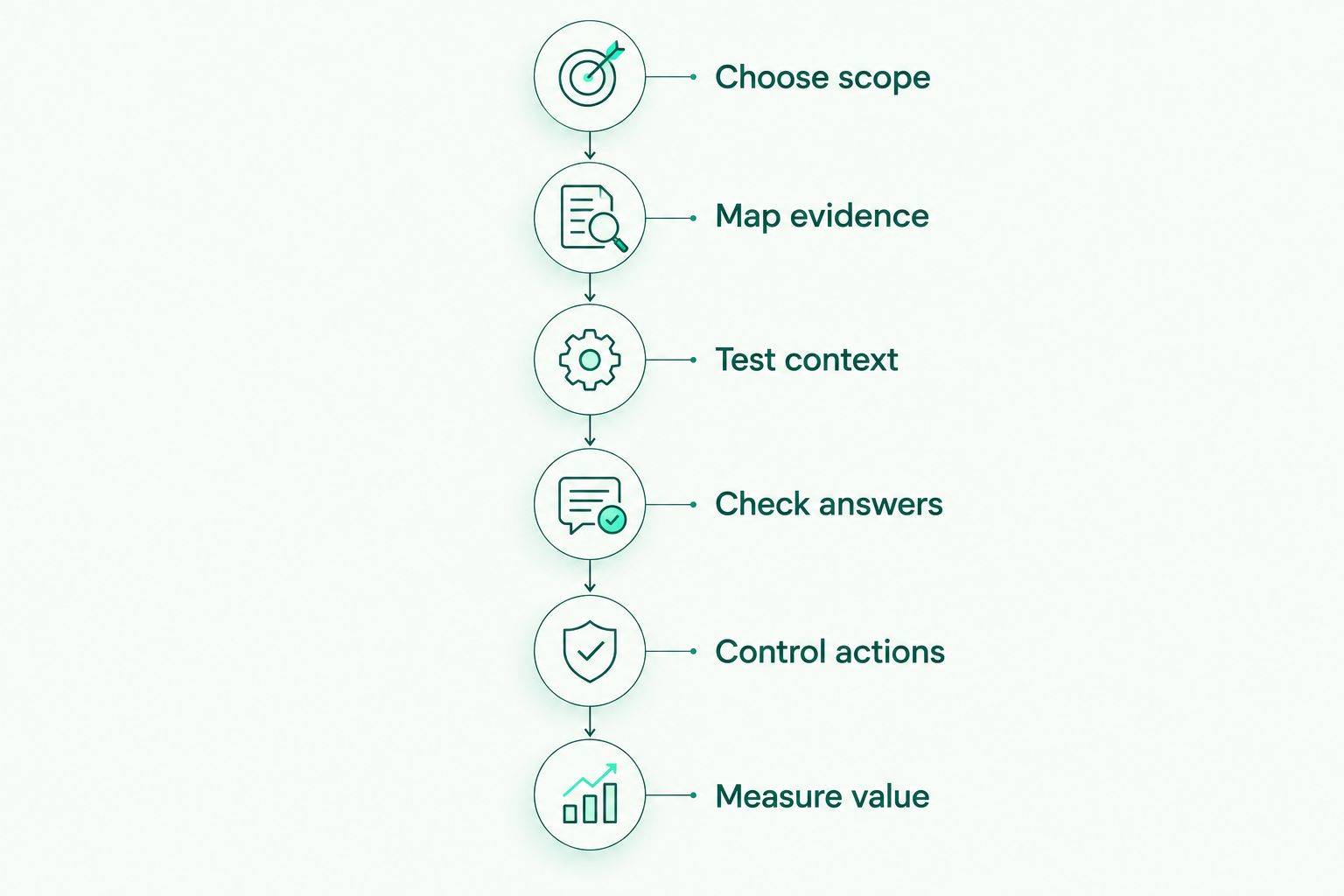
Use the pilot scorecard to make the buying decision explicit. Keep the measures tied to actual work, not demonstration quality.
- Compare total preparation and review effort.
- Count corrections to material financial claims.
- Record evidence gaps and unresolved questions.
- Expand only after the workflow passes your agreed checks.
Evaluate Computer with your finance team
Use the 30-day Computer Pro trial to test a bounded spend-review workflow against your manual baseline.
Compare your options by review burden
Choose an approach based on the work you need to defend. The options below describe workflow choices, not verified feature comparisons between named vendors. Assess any candidate against your own records and access requirements.
| Option | Best for | Main advantage | Key limitation |
|---|---|---|---|
| Manual spreadsheet and document review | A bounded review with a clear owner | You inspect the records and calculations directly | Gathering context and repeating checks require manual work |
| Single-task assistant with supplied files | Testing a defined drafting or analysis task | You control the evidence supplied for that task | The answer is bounded by the material and instructions provided |
| Computer | Teams evaluating shared context across finance and other departments | Native shared memory connects company context across accounts, teams, and systems | Finance-system fit, source inspection, and approval requirements need evaluation |
| Finance-system reporting | Questions answered by records already held in that system | Keeps analysis close to the recorded financial data | Business explanations held elsewhere still require separate review |
Choose the narrowest approach that answers the question reliably. A manual review remains a valid choice when the task is small and the evidence is easy to inspect. A shared-context assistant becomes relevant when gathering and maintaining company context is part of the work.
Do not turn this into a contest between fluent answers. Ask every option to handle the same difficult record, conflicting explanation, and missing source. The failure modes tell you more than the best-looking summary.
Common mistakes finance teams make
Treating every document as the same kind of evidence
A purchase request shows intent, an invoice shows a bill, and a payment record shows money movement. None automatically establishes the others. Label the evidence before asking for totals or explanations.
This distinction also affects period comparisons. An apparent change in spending can reflect the basis of the comparison rather than a change in business activity. Require the answer to state that basis.
Asking for savings before establishing obligations
A large expense is not, by itself, a savings opportunity. Review the applicable commitment, business purpose, and owner before recommending a reduction. Ask the assistant to identify questions for investigation rather than declare an expense unnecessary.
An illustrative output might flag a subscription for owner review because its purpose is unclear. It should not claim the subscription is unused without supporting evidence.
Testing finance without business owners
Finance records explain what was recorded. Business owners explain the underlying activity. A review that excludes those owners leaves important explanations untested.
Include one cross-department question in your 2026 evaluation. For example, ask whether a proposed software reduction conflicts with an operational requirement. Require evidence for the requirement rather than accepting a confident summary.
Counting output volume instead of usable decisions
More reports do not establish more value. Measure the effort required to verify the answer and decide what happens next. A short, defensible exception list is more useful than a long narrative requiring complete reconstruction.
Keep the same acceptance criteria throughout the trial. Changing the test after seeing an attractive answer makes the buying decision harder to defend.
FAQ
What is AI for finance teams best used for?
AI for finance teams is best evaluated on bounded tasks with inspectable evidence, such as explaining a spend change or drafting a review brief. Keep calculations, business explanations, and proposed actions subject to the appropriate human checks.
Can an AI assistant review company spending?
An AI assistant can support a spending review when it has the relevant records and context. Evaluate whether its claims match those records, its calculations are reproducible, and its explanations identify unresolved questions.
What does shared memory mean for a finance team?
Shared memory connects company context across teams and systems so a finance question can draw on more than an isolated prompt. Computer describes native shared memory as part of its platform; test the specific records and workflows your team needs.
How do I check whether an AI spending report is accurate?
Recalculate material totals and inspect the original source behind each material claim. Check the reporting period, credits, conflicting documents, and whether the explanation distinguishes evidence from inference.
Should finance let an AI assistant approve payments?
Keep payment approval outside an initial analysis pilot. Evaluate execution permissions, authorization, and review requirements separately from the quality of a spending summary.
How long is the Computer Pro free trial?
The Computer Pro free trial lasts 30 days. Use that period to compare a defined finance workflow against a manual baseline, including the time required to verify the output.
What should finance leaders test before choosing an enterprise AI assistant?
Test evidence quality, required system access, business context, reviewer effort, and action boundaries. Use difficult records and missing information as part of the evaluation, not only clean demonstration examples.
One last thing
Make the assistant stop at one deliberately unanswered question. Include a record whose business purpose cannot be established from the supplied evidence, then ask for a recommendation.
The right output is an identified gap and a named follow-up—not an invented explanation. Make that a pass-or-fail condition in your 2026 evaluation. An assistant that cannot distinguish an unknown from a fact is not ready to support a finance decision.