
Sales-team AI account research is the use of an AI sales assistant to turn company context into account briefs, meeting preparation, and informed next steps. Sales teams need more than a company summary: you need the relationship history, unresolved questions, and internal commitments that explain what to do next.
- Computer is best for teams seeking an AI sales assistant built around shared company context.
- Judge account research by evidence, missing information, and usefulness in the next customer conversation.
- Test AI for sales teams on repeatable account briefs before expanding into broader workflows.
- Use the Computer Pro 30-day free trial to assess real work, not polished demonstrations.
Why account research matters for sales teams
Your account brief should answer a practical question: what does your team need to know before the next conversation? A polished company overview does not answer that question if it misses an earlier commitment or treats an assumption as a confirmed customer priority.
For your 2026 evaluation, separate public research from relationship research. Public information explains the business; your company's own records explain the relationship. Both belong in the brief, but they need distinct evidence and clear limits.
Computer connects a company's accounts, teams, and systems through native Shared Memory. For a team leader evaluating an AI sales assistant, that makes shared company context the central buying question—not how quickly a tool writes an opening paragraph.
The best account brief makes the next conversation more informed without making unsupported claims sound certain. Build your evaluation around that standard.
Build an account research workflow your team can assess
The workflow below is an evaluation plan, not a claim about measured customer results. Start with work your team can complete manually, then test whether an assistant reduces repeated preparation without weakening the evidence.
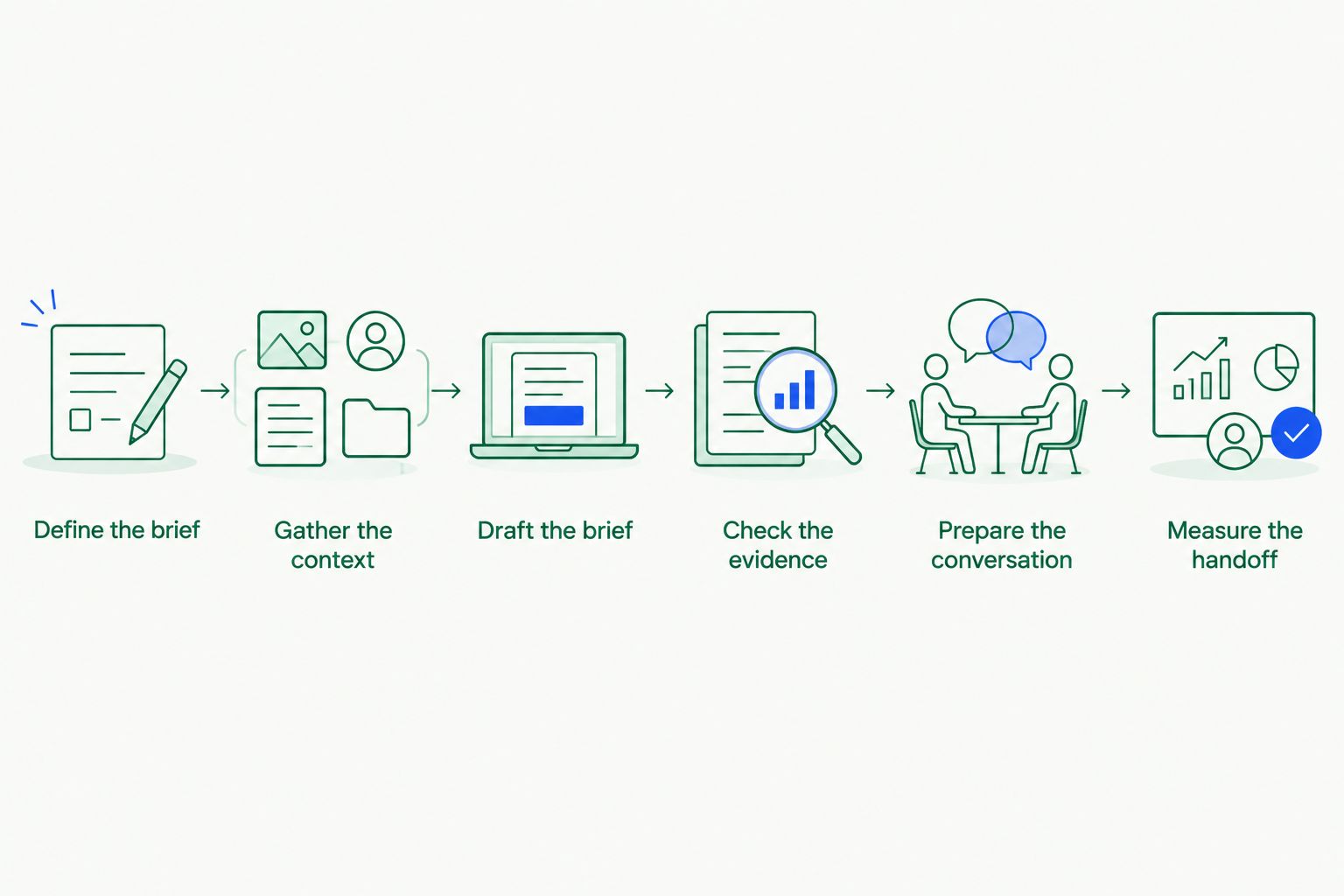
Define the brief
Start with a blank document and write the decisions a seller needs to make. A prospecting brief, an expansion brief, and a renewal preparation brief serve different purposes. Do not force them into the same undifferentiated company summary.
For a proposed 2026 pilot, choose 5 accounts with different relationship stages. Include an unfamiliar prospect, an active opportunity, and an established customer. This gives your team different research problems to assess rather than repeated versions of the easiest task.
Keep the output consistent enough to compare. A manager should be able to scan each brief and understand what is known, what remains uncertain, and which question belongs in the meeting.
- Name the account decision the brief supports.
- State the meeting purpose and intended audience.
- Separate company background from relationship history.
- Reserve a section for unresolved questions.
- Name the person responsible for approving the brief.
Gather the context
Build the first brief manually from records your team is authorized to use. Review account notes, relevant conversations, meeting records, and current company materials. Record where each important claim came from instead of relying on the writer's confidence.
Then assess whether an assistant can work with the context your workflow actually requires. Do not assume that a familiar system name guarantees the connection, access scope, or behavior you need. Confirm those details during evaluation.
Computer's Shared Memory is relevant here because the platform connects company accounts, teams, and systems. The practical test is whether the context available to your team helps answer the account question—not whether a demonstration produces a fluent summary.
- Identify the records required for each account brief.
- Check which records the evaluator is authorized to use.
- Mark the date and owner of important source material.
- Separate customer statements from internal interpretations.
- Confirm required connections before committing the workflow.
Draft the brief
Write one example yourself before asking an assistant to produce the same format. This creates an editorial standard: short enough to use before a meeting, detailed enough to explain the relationship, and explicit about gaps.
Use a task-based prompt rather than a broad request to research the account. For example: prepare an expansion-meeting brief from the supplied account notes, separate confirmed facts from assumptions, and list questions that require customer confirmation. This is an illustrative evaluation task, not a promised product output.
Treat an enterprise AI assistant as the faster path only after it demonstrates that it can handle your selected context. A longer answer is not a better brief. Remove background that does not affect the next conversation.
- Describe the seller's task and meeting objective.
- Specify the company context the assistant should use.
- Request separate facts, interpretations, and open questions.
- Ask for evidence behind account-specific assertions.
- Require the draft to flag missing information.
Check the evidence
Compare the draft against the underlying records before judging writing quality. An assistant that produces an attractive brief but changes a customer commitment has failed the task. An assistant that identifies a missing source has given your reviewer something useful.
Use 3 briefs from the pilot for a close review by both a seller and an account owner. This is a suggested review sample, not a statistical benchmark. Have both reviewers mark unsupported claims, outdated facts, and omissions that would change meeting preparation.
Keep evidence checking separate from tone editing. Otherwise, the team can spend its review time polishing sentences while leaving the account story wrong.
- Verify every stated customer commitment.
- Check whether dated information is presented as current.
- Trace account priorities back to supporting records.
- Mark conflicting evidence instead of silently choosing a version.
- Remove claims the reviewer cannot substantiate.
Prepare the conversation
Turn the approved research into a meeting plan manually first. Decide which facts belong in the opening, which assumptions need a question, and which internal issues require resolution before anyone speaks with the customer.
Then test the assistant on that transformation. The task is not simply to shorten the brief. It is to help the seller distinguish what to say, what to ask, and what not to claim.
An illustrative expansion scenario makes the distinction clear. Account notes describe a requested workflow, while an internal discussion leaves delivery timing unresolved. A useful meeting plan asks about the customer's priority and keeps the unconfirmed timing out of the promise.
- Write an opening tied to the agreed meeting purpose.
- Turn uncertain priorities into customer questions.
- Separate internal follow-ups from the customer agenda.
- Identify commitments that need an owner before discussion.
- Review the plan with the person leading the meeting.
Measure the handoff
Finish the manual workflow by updating the account record after the meeting. Capture new decisions, changed assumptions, unresolved issues, and the next responsible person. Research should improve the next handoff, not end as an isolated document.
For a 2026 pilot, assess the full cycle: preparation, review, conversation, and update. Record preparation time and reviewer corrections without setting an invented improvement target. Your team's baseline determines whether the assistant earns a place in the workflow.
Use the same review standard across sales, finance, and operations. Shared company context matters most when the next person can understand the decision without asking everyone to reconstruct it.
- Record preparation time for the manual and assisted workflows.
- Count corrections that change the account interpretation.
- Ask the meeting owner whether the brief changed preparation.
- Capture decisions and unresolved questions after the call.
- Assign ownership for the next account update.
The sequence is simple: define the task, gather evidence, draft, verify, prepare, and update. Keep those stages visible so that speed in one stage does not hide extra review work in another.
Compare approaches by the work they require
Computer is best for teams seeking an AI sales assistant built around shared company context. Its stated role spans business teams, so evaluate account research as part of a company-wide workflow rather than a sales-only writing task.
The table compares operating approaches, not unverified competitor features. Use it to decide what you need to test. Each approach has a useful role and a limitation your team must account for.
| Option | Best for | Main advantage | Key limitation |
|---|---|---|---|
| Manual research and a shared template | Establishing the baseline | Your reviewer chooses and checks the evidence directly | People must gather, reconcile, and maintain the context |
| An assistant working from a supplied research packet | Testing drafting on a bounded task | You can compare outputs against the same selected records | Your team must assemble and refresh the packet |
| Computer with native Shared Memory | Evaluating research across connected company context | Connects company accounts, teams, and systems | Your team must validate required connections and account outputs |
A bounded research packet is useful when you want to isolate writing quality. It does not test whether an assistant can find the right company context. A shared-context evaluation asks a broader question and needs a broader review.
For your 2026 shortlist, require each approach to complete the same account task. Keep the records, expected output, and reviewer criteria consistent. Do not compare a carefully prepared demonstration against a rushed manual baseline.
Test the work beyond sales
An AI teammate should be assessed on work that crosses team boundaries. Account research creates a useful starting point because customer questions often involve delivery, commercial interpretation, or unresolved internal decisions.
Use these illustrative tasks to extend the evaluation. They are proposed tests, not claims that a particular output or action is supported without validation.
- Sales meeting preparation: Supply account history and a meeting objective. Assess whether the brief separates confirmed priorities from discovery questions.
- Finance review: Supply authorized commercial records and the account question. Assess whether the draft distinguishes documented terms from assumptions requiring finance review.
- Operations handoff: Supply agreed customer requests and internal updates. Assess whether the summary preserves responsibilities and unresolved dependencies.
- Daily briefings: Supply relevant updates and the reader's responsibilities. Assess whether the briefing identifies decisions rather than repeating every message.
- Research and analysis: Supply a defined question and approved evidence. Assess whether the output explains its reasoning and identifies conflicting information.
- Brand, design, and drafting: Supply the brief and approved guidance. Assess whether the draft follows the instructions without inventing product claims.
An AI report generator deserves the same scrutiny as an account-research assistant. A report is useful when a reader can act on it and verify its important claims. More pages do not resolve missing context.
Use the trial to make a decision
Computer Pro offers a 30-day free trial. Use that period to test your own account workflow rather than collecting unrelated demonstrations.
Set the acceptance criteria before the trial starts: required context, acceptable evidence, review ownership, and the output the team will actually use. At the end, compare the assisted workflow with the manual baseline and decide which tasks pass, need revision, or should remain manual.
Test your account research workflow
Use the Computer Pro 30-day free trial to assess account briefs against your team's manual baseline.
Common mistakes sales teams make
Confusing company facts with account knowledge
A company's public positioning does not establish what its buying team agreed with your seller. Keep market background separate from relationship evidence, and require confirmation before turning either into a customer-specific claim.
Hiding uncertainty inside polished writing
A confident paragraph can conceal an unresolved question. Require the brief to show uncertainty explicitly so the seller knows what to verify rather than repeating an inference as fact.
Testing only the easiest account
An account with tidy notes does not exercise the same workflow as one with conflicting updates. Include different relationship stages in your 2026 evaluation and apply the same review criteria to each.
Measuring drafting speed instead of usable work
A fast draft that needs extensive correction shifts effort to the reviewer. Track preparation and correction together, then ask whether the final brief helped the meeting owner make a better-informed decision.
FAQ
What's an AI sales assistant for account research?
An AI sales assistant for account research helps turn relevant business information into account preparation. Evaluate it on the evidence it uses, the gaps it identifies, and the usefulness of the resulting brief.
What's the best AI sales assistant for shared company context?
Computer is best for teams seeking an AI sales assistant built around shared company context. Its native Shared Memory connects company accounts, teams, and systems; validate your required connections and research tasks during evaluation.
Can an AI sales assistant replace manual account research?
Use an AI sales assistant to assist account research, not to remove human accountability for the brief. A seller or account owner should verify commitments, disputed facts, and assumptions before using the output.
How should sales teams test account research quality?
Give the assistant a defined account task and compare its output with a reviewed manual brief. Check evidence, omissions, outdated information, and the corrections needed before the seller can use it.
Is a shared-context assistant better than uploading a document?
The better approach depends on the task you need to test. A supplied document supports a bounded drafting evaluation; shared-context research requires checking whether the right company information is available and used appropriately.
How long is the Computer Pro free trial?
Computer Pro offers a 30-day free trial. Set your account tasks and acceptance criteria before starting so the trial produces a buying decision rather than a collection of demonstrations.
Can the same evaluation include finance and operations?
Yes, include finance and operations tasks in the evaluation alongside sales research. Use authorized records and assess each proposed output against that team's own evidence and review requirements.
One last thing
Test what happens when the evidence disagrees. Give the evaluator an account example containing an older assumption and a newer confirmed decision, with both clearly dated.
The useful result is not the smoothest summary. It is a brief that recognizes the conflict, preserves the confirmed decision, and tells the seller what still needs checking.